Is StarLink practical or not?
Hello, I'm incompetent.
Since it's a property from the 1990s or later, I thought, "(ヽ´ん`) It must have fiber optic infrastructure," but surprisingly, it didn't...
It seems other residents are also using mobile Wi-Fi routers, which is bad... I completely overlooked this, but I can't turn back now, so I need to do something.
Is StarLink practical?
Yes, StarLink is what caught my eye.
It's Elon, who's always in the news, but currently, StarLink is the only option for civilians to use satellite internet communication.
Starlink | IIJ Engineers Blog
Reading IIJ's blog, it seems quite good, with speeds of around 200Mbps being generally stable.
It seems that it becomes difficult to pick up signals when the weather is bad, and if water gets on the antenna surface, the quality drops sharply, so if installed in a covered location, it might be quite usable.
What's the difference between Residential and ROAM?
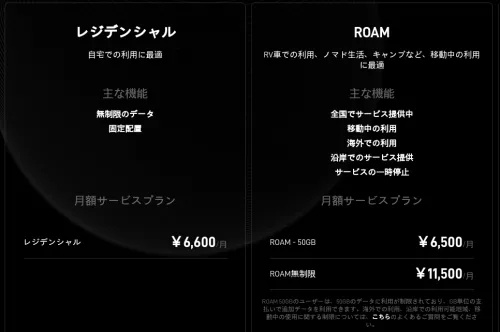
For personal use, one would probably use Residential or ROAM, and I thought, "Why not get a ROAM contract and use it like Residential?" but it seems impossible. The speed drops to ~50Mbps, and I'd likely inadvertently violate some strict radio wave regulations, so I gave up on that idea.
| Feature | Residential | ROAM |
|---|---|---|
| Download Speed | Around 200Mbps | Around 50Mbps |
| Price | ¥6,600/month | ¥11,500/month (Unlimited) |
Differences between Fiber Optic and Starlink
I'm not sure if there are any benefits, but the installation cost for fiber optic is equivalent to the Starlink hardware price, so in that regard, it might not be much different.
If Starlink costs ¥6,600, it becomes more expensive than other good fiber optic plans.
However
What seems surprisingly powerful is the ease of switching between ROAM and Residential.
You can use the internet virtually anywhere when traveling. I don't know how far it works overseas, but it might eliminate the need to buy prepaid SIMs.
Even for a home server, it seems possible to build a LAN using a separately sold Ethernet adapter, so this point also seems fine.
No worries even during disasters, but in Japan, the communication infrastructure is quite well-developed, and even if there's an outage, recovery speeds are incredibly fast, so saying "even during disasters" might be a bit misleading when compared to Japanese networks.
| Fiber Optic/Starlink | Max Communication Speed | Initial Cost | Price |
|---|---|---|---|
| Fiber Optic | 10G | Around ¥30,000-¥40,000, many chances for free installation | ¥3,000~¥6,000 |
| Starlink | 200M | ¥35,000~¥50,000 | ¥6,600 |
Can I use a used Starlink device?
I looked into it, but since the device is linked to the subscriber's information, a new user apparently cannot use it indefinitely unless a transfer process is completed.
Therefore, there isn't much used inventory, and it's not cheap, so it seems better to buy a new device.
Or rather, upon closer thought, if you buy it and then sell it, a portion of the initial cost is effectively recouped.
Before, there were clearance sales at Costco, but now it seems to be sold for around ¥38,000 online at Bic Camera/Yodobashi, which is quite a bargain.
Conclusion: I'm going to start using Starlink for everyday use (as a guinea pig)
I see comments like "it's good for a backup line," but probably not many people intend to use it as their main line.
The problem is that it's often judged as a US address by GeoIP, so not being able to use many Japanese services is tough.
That said, I don't subscribe to any Japanese services myself, so I don't think it will affect me much...
Well, if it's really too difficult, I'll probably get fiber optic installed.
See you then.
Thank you in advance.