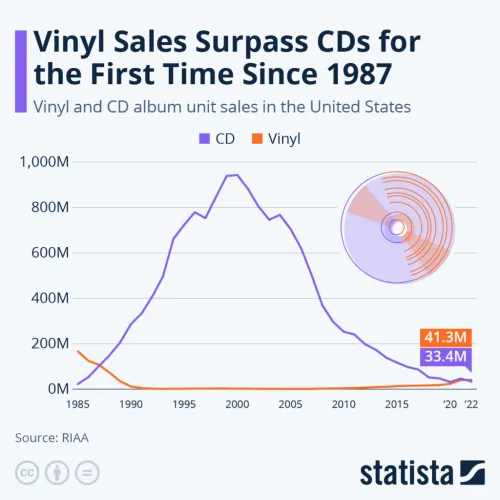
For the first time since 1987, vinyl sales surpassed CDs - The paradigm that analog culture will remain
https://www.zerohedge.com/personal-finance/vinyl-sales-surpass-cds-first-time-1987
Source
Let's also look at sales in Japan.
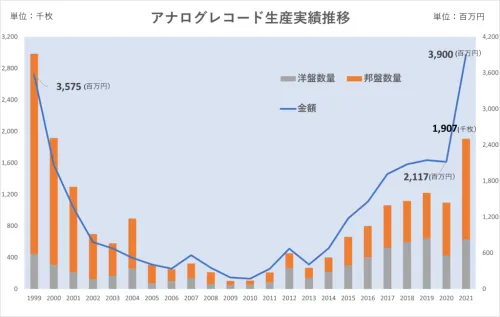
Why is it increasing?
Digital fatigue?
Looking at it, vinyl records started to be bought a little in the US from 2010, and in Japan, they started to be bought after hitting a low in 2009.
Considering this, isn't it correlated with the spread of smartphones?
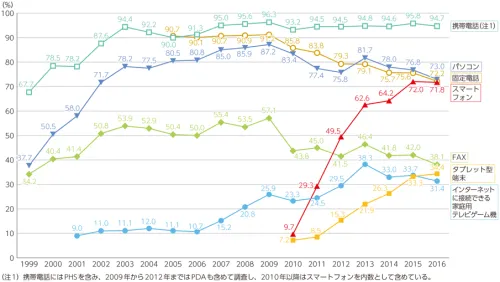
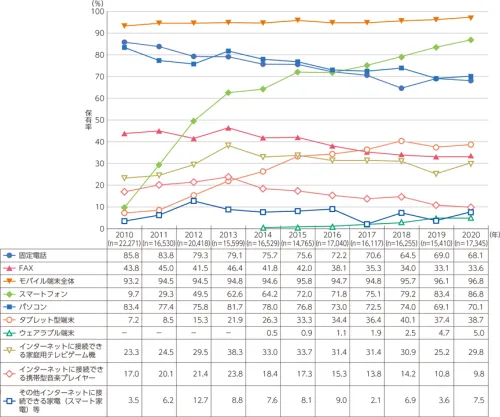
Ministry of Internal Affairs and Communications - Trends in the Ownership of Information and Communication Devices in Japan
Now, with the abundance of subscription services, you can listen to new music anytime, anywhere, 365 days a year.
You can even listen for free on YouTube.
But the sound doesn't change significantly from there.
It's not a matter of equalizers, but of how it's heard. Both Apple Music and YouTube are full of popular music, playlists, and trending lists, and such music can exhaust the mind.
This is because trends are similar to the blooming and scattering of cherry blossoms. Even if cherry blossoms bloom and scatter daily, the freshness is lost.
When popular songs are all about impact and memorability, you become overwhelmed by the sheer volume of information.
Will analog win?
I don't think that's the case.
Once the latest spec CPUs and GPUs are released, would a model with lower performance be accepted?
Perhaps this is a visible plateau in the performance of PC and smartphone businesses.
It's no exaggeration to say it's already happening. I feel like a similar situation has occurred before, but at that time, AMD's "Polaris" and "Ryzen" were complete game-changers.
For general use, what lies beyond further performance increases in smartphones?
Considering how long the surge in popularity for analog will last, it probably depends on the development of QPUs (quantum processors).
For generations who have never handled records before, transitioning from being tired of digital sound to analog records is perceived as "something new they're hearing for the first time." If a new music business using QPUs were to emerge, people might shift their interest to that new development.
Towards a world of coexistence
The premise so far is that you can listen to any music you like, freely, anytime, anywhere, just like now.
Perhaps the value of digital music has been continuously diluted since the birth of CDs in the 1980s, making it more accessible and easy to handle.
Ultimately, with subscription services, you can listen to music from all over the world for about 1000 yen per month, or about 12000 yen per year. Gradually, you realize that the money spent on payments leaves nothing tangible behind.
As a new approach to music, can records still gain prominence?
We must not forget the possibility that this might be one sign of a move towards hyperinflation.