Storage Market Collapse and Decentralized Storage as a Lifeline - In Exchange for Lifespan
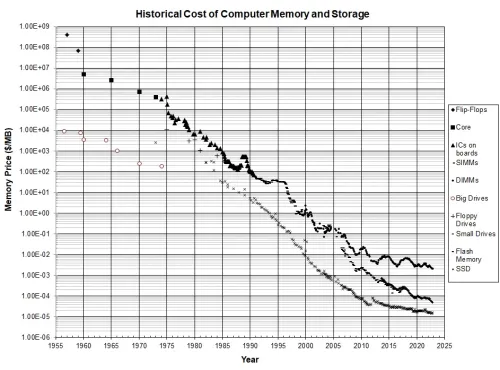
Storage-related products are already experiencing a price collapse.
3 to 5 years ago, a 128GB SSD cost over 10,000 yen, but now you can buy one for less than 3,000 yen.
Why has it become so cheap?
Semiconductors for Everything
Now, with the increased demand for cars, smartphones, and PCs due to COVID-19, the demand for semiconductors has risen.
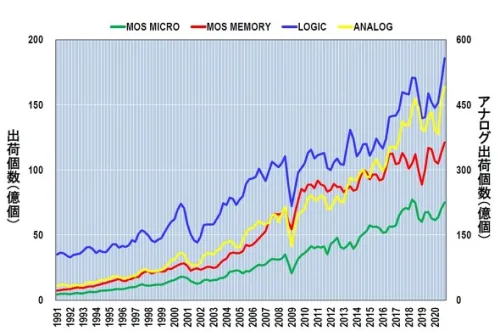
Semiconductors are in everything.
Indeed, everything demanded semiconductors. They were indispensable for technological progress.
However, regarding SSDs mainly incorporated into PCs, it seems that SSDs began to spread from SLC NAND in the past, and mainly from MLC NAND for general use.
As everyone knows, Toshiba's "Toshiba Memory" sustained itself solely on its semiconductor business, despite the parent company's deficits.
And Toshiba's outstanding semiconductor business was spun off, becoming the current "Kioxia".
Currently, TLC and QLC have followed a path of degradation in exchange for lifespan.
This is to keep prices low and sell in response to demand.
From the author's perspective, I felt that NAND flash memory was approaching its end when QLC was born. Why is that?
TLC records 3 bits/cell, and QLC records 4 bits/cell. QLC allows for higher-density recording, enabling more data to be stored on a single chip.
This leads to a higher likelihood of high-load environments, increased heat generation, accelerated chip degradation, and a shorter lifespan for the elements.
However, failures are rare in general use. More often than not, it's the controller side that fails, rather than the NAND itself.
Is there really such a demand for storage?
A long time ago, a coffee shop owner who regularly painted watercolors consulted me about buying an iPad.
It seemed they were troubled by storage capacity.
At that time, I said:
"Can you really use up all that capacity? And if the capacity increases, you'll naturally stop looking at old things."
As a talkative idiot who hasn't really studied much, no one usually takes my words seriously, but on this point, they said, "That's certainly true."
From a user's perspective, even if such large-capacity devices become more common, can they really use them all up?
Even if capacity increases, the opportunities to buy new replacements will disappear, and the necessity will diminish.
Yes, they simply won't be bought anymore.
This is leading down the path of market collapse.
The Lifeline is Decentralized
As a market, if general users don't buy, prices will fall.
However, that memory is not just garbage; it has availability. It is capital-rich companies that find value in it.
Skynet by Sia, a decentralized storage service that I also used in the past and had an easy-to-use UI, ended its service due to a lack of funding.
There's also Storj, which offers 150GB for free, but its UI is too difficult to use, so its users will likely be limited.
However, new entrants include the TON Foundation, launched by the former Telegram team, Binance's BNB Chain (a CEX-type cryptocurrency exchange), Huawei, and others.
Storage can also be used in virtual environments, such as cloud providers, in addition to online storage. Its affinity with big data, a term now considered outdated.
Services like Mega and OneDrive, which existed in the past, are moving towards business contraction by terminating services or reducing capacity.
But will that demand disappear? I don't think so.
Being able to view data anywhere, even without holding the storage medium in hand, would be convenient, and data sharing between PCs and smartphones would also be useful.
Security of Decentralized Data
Even if one node goes down, with a decentralized system, data is protected as long as the majority of nodes do not go down.
With Mega's free plan, data is deleted if you're logged out for 3 months. But with decentralized systems, you can rest assured.
Even if there is no demand from general users, if data security is guaranteed, there should be high demand from other companies that currently own their own servers.
There are also current issues with data integrity, synchronization processing, networking, etc., so when these challenges are resolved, the world as we know it might change again.