Moving is Somewhat Complete
Hello, I'm incompetent.
The necessary luggage has arrived, and the moving process is somewhat complete.
I really wanted to do more, but I arrived in the morning yesterday by overnight bus, assembled furniture, unpacked, and then slept like a log at night, so I guess I was still tired and ended up napping for about two hours.
By the time I ironed my suit and coat, about two hours had passed, and now it's already this late after doing some sewing.
date
2025年  1月  4日 土曜日 23:21:05 JST
Honestly, I always wore casual clothes for work, but opportunities to wear a suit are quite rare, so I want to make sure I wear it properly when the time comes.
It's a 90s Onward Kashiyama suit I received from a math major friend who also loves vintage. The suit fabric is high-quality herringbone twill, reminiscent of the bubble era, and the lining has a diamond-like pattern, typical of 1960s American vintage.
Of course, there are high-quality suits from British and American brands, but it's hard to find ones that fit Japanese body types, and often the arm and waist sizes don't match.
I suppose it's inevitable that in this accelerating era of mass production and consumption, Onward Kashiyama has also had to adapt to cost-cutting trends.
I now have a standing desk
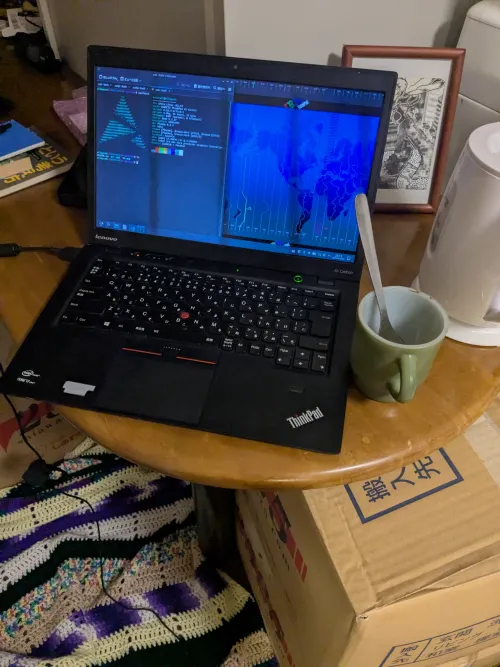
As you can see in the photo, there was a round table at my new place, so I can now work while standing.
I have a Karimoku sofa for when I get tired, so that's enough.
Originally, I used my home PC desk since I was in high school, but my legs would get numb, and sitting down to work often felt like a hassle, so I rarely used a chair at home anymore.
It's more comfortable than I expected.
The 1.5Mbps World
I had originally planned for Starlink, but I've decided to put it on hold for now.
There's a possibility that getting a US geoip when using it for work could cause some issues.
Additionally, I've found that I can manage quite well even with 1.5Mbps.
I'm using a service called mineo's Packet Hodai Plus, which is like a bug – for about an extra 250 yen on a 1GB plan, you get unlimited 1.5Mbps communication in low-speed mode.
If you're just doing basic SSH and CLI operations, it's more than enough speed.
However, it's practically unusable for downloading hundreds of MBs using a package management system, so when I need to do that, I SSH into my home server at my parents' house in Sendai and use its fiber optic environment.
Even YouTube is quite comfortable to watch at 1.5Mbps.
Whether I get a new line or subscribe to Starlink, it will probably be at the end of this month or next, but in the meantime, I plan to enjoy the 1.5Mbps world.
I wouldn't be surprised if I discover some inconveniences on websites that I hadn't noticed before.
Regarding Life
Perhaps it's because I used to visit my brother's house frequently during long holidays, but there are many independent second-hand shops in Tokyo, so there might not be much need to bring a lot of furniture.
Since it's a city with a rapid turnover of people, there are many items sold at low prices, effectively like American thrift stores (I haven't been due to COVID, but I've heard a lot about them).
American thrift stores operate on a system where wealthy individuals donate to thrift stores to receive tax deductions, and the thrift stores then sell items at low prices to provide goods for low-income individuals.
At the same time, they actively employ people with disabilities, thus also serving a social welfare function.
Also, food items aren't much different from Sendai.
However, Sendai had a place called Sendai Morning Market where you could buy things at almost outrageously low prices, but there's nothing like that here.
When it comes to seafood, I guess some things are just unavoidable.
awk error output
My friend Iigau-kun enthusiastically told me about awk, and since I had been curious but hadn't gotten around to it, I decided to try it out.
#!/usr/bin/awk -f

# Usage
##############
# $ ./err.awk a
# $ echo $?
# $ ./err.awk 1
# $ echo $?

BEGIN {
  stderr = "/dev/stderr"
  if (ARGV[1] ~ /[A-Za-z]/) {
    print "Error:", "i don't understand it eng" > stderr
    exit -1
  }
}
This is a trivial script that simply returns 'I don't understand that English' if an alphabet character is given as the first argument, treating it as an exceptional error with error output and a return value.
Iigau-kun was excited that C language control structures can be used as they are! That's certainly true.
And the ability to write without worrying about pointers or memory management is excellent for an interpreted language.
I've been looking for a versatile alternative to shell scripts recently, so this is good.
This is because there are quite a few differences between bash, which I personally use on GNU/Linux, and csh, the default shell adopted by FreeBSD, so adopting awk, which allows pipes and such to be used directly, is quite a viable option.
What Do Today's Workers Seek?
Before leaving Miyagi Prefecture, when I met a friend, I was smoking in the smoking area and unexpectedly ran into two classmates from elementary and junior high school.
Though it had only been two years.
Both of them are in sales, one in my hometown and the other in Osaka, and both said they wanted to change jobs.
So, what about technical professions?
The future pioneered by the "outrageous" spirit - IPA's Mr. Nobori talks about Japan's revival strategy as a technology powerhouse (1/3)|CodeZine
Mr. Daiyu Nobori is quite eccentric, but he repeatedly says that it's about creating playgrounds.
But I certainly feel that way too.
Because I also started using computers to play by myself.
Increasingly Complex Development Environments
Numerous frameworks are created, numerous languages are born, numerous package management systems emerge, and numerous Linux distributions exist, forcing us to endure hardships.
And it might indeed be difficult for engineers to learn new things in a strictly regulated corporate environment.
That being said, my knowledge is limited, but I still want to convey at least a millimeter of the joy of interacting with computers myself.
The websites about repairing junk items that I eagerly read during my student days are mostly gone now, with only about one still remaining and updated, but thanks to those people back then, I thought I might be able to do it too, and here I am today.
And it's not just about computers; I think it's fine if I can enjoy other things too, like music and clothes.
Before I knew it, I've turned 23, having spent all my time doing what I love.
Will AI Solve Everything?
Code generation and PC-related topics are endless, and I strongly feel the benefits of large language models; they are like teachers who can teach you anything.
However, upon closer inspection, it would be great if the sustainable costs invested in these AI services were lower than human costs, but that is not currently the case.
I don't subscribe to all AI services, but they usually cost a few thousand yen, which seems cheap, but where do the costs for such cheap usage come from?
For OpenAI, it's large investments from Microsoft and others.
For Anthropic, it's large investments from Amazon and others.
And government subsidies.
The GPUs invested for their training cost millions of yen from NVIDIA, plus the electricity costs to maintain them and infrastructure costs for other storage.
*NVIDIA strictly regulates the use of expensive GPUs like the H-series for research and commercial purposes under its license. Therefore, RTX series, etc., cannot be used under the license.
It would be great if they could be used permanently, but I also feel that beyond that, it's not very realistic.
So, has C language, for example, disappeared in the last 50 years?
No, it's still used in critical parts like the OS kernel for machine learning.
Indeed, similar pains were felt in the 1970s when factory mechanization advanced and the industrial revolution occurred.
Did humans disappear from factories afterward? In the last 50 years, there are probably fewer places operating completely unmanned. Certainly, the long-term trend of reducing human labor will not disappear, but if it were to have a significant impact on the real economy, it would become a global problem, reaching a level far beyond what individuals could handle.
In the first place, if a factory mass-produces goods but they cannot be consumed, the factory loses its meaning.
Ultimately, what I want to say is that looking at the dark history of the past, it's clear as day that the economy I live in still persists.
I believe that the only things an individual can do are to strive to solve immediate problems and to enjoy the present without anxiety.
In a speculative society, it's understandable to feel rushed by the rapid pace of change and engage in deviant behavior. Of course, my life has been full of failures, but isn't it enough if I can focus on my happy moments and create lasting memories, like eating with friends, spending time doing what I love, discussing or not discussing things at work with myself and others, and spending time with family?
Sometimes I drink machine-made alcohol sold at convenience stores, but pubs and bars still exist today.
Well then, until next time.
Best regards.