Aging in Japan led to inflation suppression... America is also following that path
There was an article with a rare perspective, so I'm copying and pasting it entirely for myself as a mirror.
Indeed, it might be that thanks to conservative people, particularly older individuals who experienced the severe collapse of the Japanese bubble in the past, there was a tendency not to shift to excessive inflation.
However, there's a possibility that this could end soon.
-
Phil Rosen [Original text] (Translation: Ayako Nakata, Editor: Toshihiko Inoue)
-
Dec. 11, 2023, 09:00 AM International
-


Japan's aging population may offer clues to predicting US inflation trends.
Xinhua News Agency / Getty Images
-
Eurizon strategists predict that US inflation will surely fall to the Fed's target of 2%.
-
They cite Japan as an example of how demographic trends change economies over time.
-
Since the 1990s, aging in Japan is said to have led to lower inflation and interest rates.
While some on Wall Street expect US inflation to struggle to fall to the Federal Reserve's (Fed) target of 2%, Eurizon SLJ Capital points to the opposite. They cite Japan, where aging led to inflation suppression, as an example, suggesting that the same will happen in the United States, the world's largest economy.

Eurizon strategists Stephen Jen and Joana Freire noted in a client memo published on November 27, 2023, that Japan is a real-world example of how aging has impacted inflation suppression, and that this applies globally and, of course, to the United States.
In the US, the Consumer Price Index rose 3.2% year-over-year in October. This was the lowest level since June, a deceleration from 3.7% in September.
Past data from Japan, South Korea, Italy, and China—which JPMorgan has warned could face "Japanification"—all indicate that changing demographics lead to disinflation (an economic state where the pace of price increases slows due to monetary tightening policies, etc.).
"As many countries age, it is likely to have a significant impact on inflation. While each country will inevitably fight this demographic headwind, the ultimate outcome of aging will likely remain unchanged," Jen and Freire stated.
Japan, one of the world's oldest economies, began its full-scale aging in 1990, and since then, inflation and interest rates have declined. Low inflation persisted for 30 years, despite the Bank of Japan's attempts to stimulate demand with unconventional monetary policies.
"The collapse of Japan's triple bubble (stocks, real estate, and investment) in 1990 may have had a suppressive effect on economic growth and inflation in subsequent years due to the dynamics of a balance sheet recession (where excessive private sector debt hinders long-term growth). However, it is unreasonable to attribute what is happening now to events that occurred more than 30 years ago."
According to Eurizon's calculations, Japan's labor force peaked in 2019, reaching 1.7 times its 1950 level. This means the working population increased by an average of 0.77% annually.
Although it was initially thought to have peaked in 1997, dramatic policy efforts managed to postpone the ultimate peak by about 20 years.
China was also expected to peak in 2018, but new policies are likely to postpone it. Meanwhile, the US is projected to see its labor force peak delayed due to immigration.
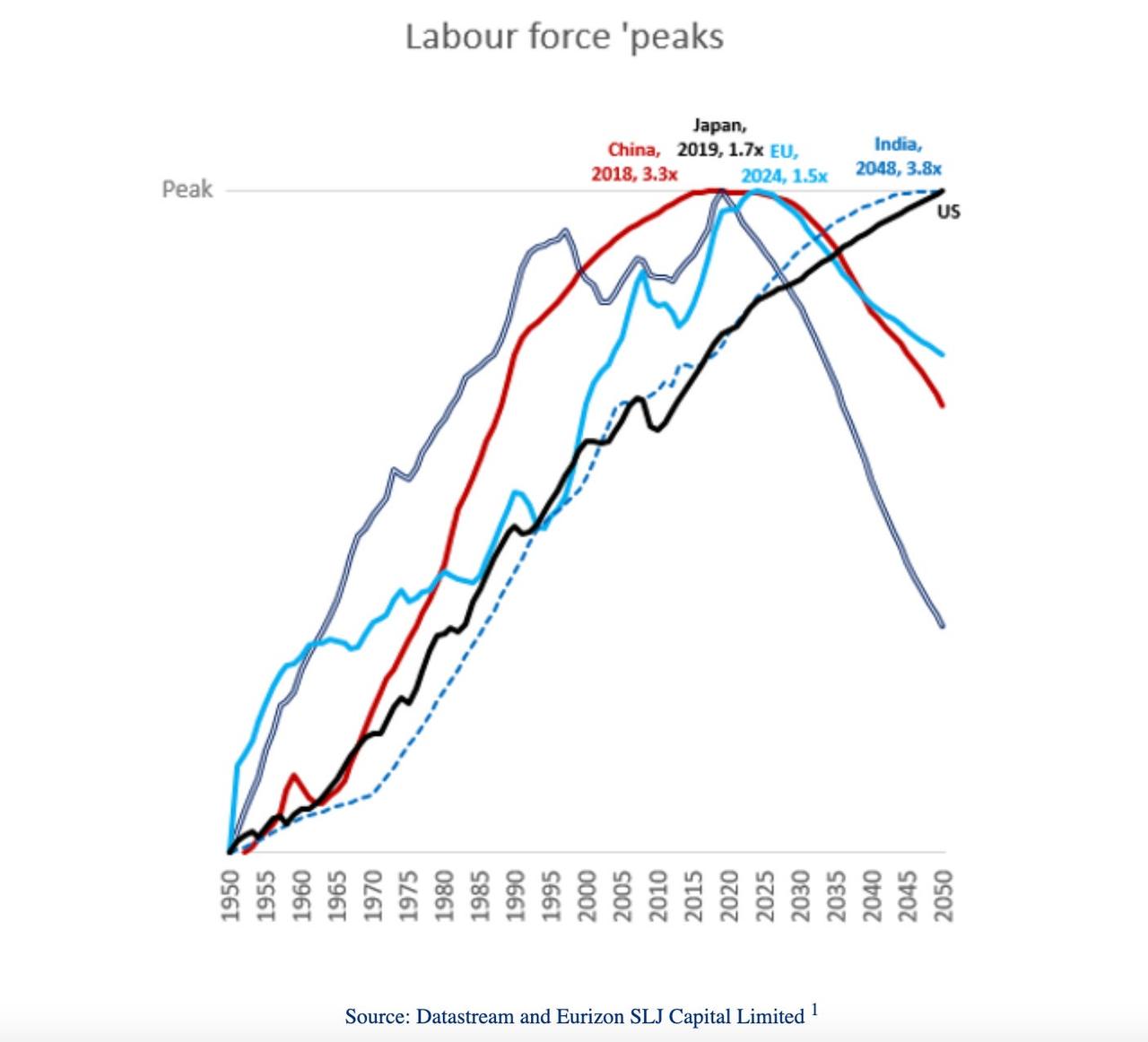
Trends in the labor force population estimated by Eurizon for China (red), Japan (gray), EU (light blue), India (blue dashed line), and the US (black).
Eurizon SLJ Capital Limited
As more countries follow Japan's demographic trends, their inflation rates will likely follow a similar trajectory.
Eurizon believes that even the COVID-19 pandemic could not change the relationship between demographics and inflation. Rather, the sharp decline in employment and subsequent gradual recovery led to a decrease in inflation without a surge in unemployment.
Eurizon's note states:
"In the short term, there is even a risk of immediate deflation, as the general price level already appears too high. In the long term, the inflation rate in the new steady state (the level to which it converges in the medium to long term) will only be slightly higher than the low levels seen before the pandemic."
Bank of America economists say that the latest inflation data indicates that the Fed's rate-hiking cycle has officially ended. They believe that if policymakers consider raising rates again in 2024, it would only be if price increases significantly accelerate.