An Analysis: When Will Soaring Prices End and the Stock Market Bottom Out?
Hello.
I'd like to record what the continuing surge in prices and stock market collapse mean, and what the future movements will be, as a personal memo.
First, the CPI index, which represents consumer prices and is a factor in the price surge.
And the PPI index, which represents wholesale prices.
The source is the annual report and others issued by the Economic Planning Agency.
Sorry for the patchwork, as there are no 50-year charts available.

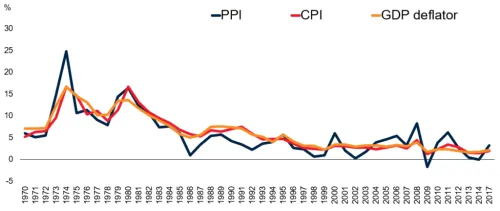
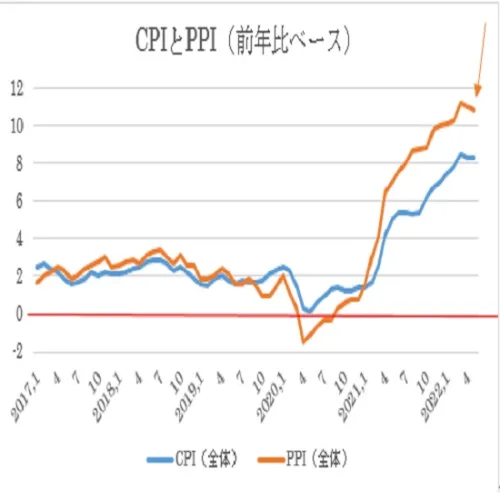
https://www5.cao.go.jp/keizai3/sekaikeizaiwp/wp-we74/wp-we74-000i1.html
Looking at the 1974 annual report, similarities with the current year 2022 include concerns about stagflation, soaring commodity prices, rising gold prices, stagnation in the communist bloc*, and material shortages.
*In 2022, China's trade balance is stagnant. However, Russia, which received economic sanctions from the US due to the Ukraine issue, is earning foreign currency and profiting thanks to energy exports, including natural gas exports via Nord Stream to Europe, which relies on Russian resources, and crude oil sold to India & soaring crude oil prices.
This point is also recorded in the annual report regarding the rapidly recovering Russian economy.
Compared to 1973, which saw a double-digit growth rate due to the oil shock, the current growth rate as of June 2022 is 8.6%.
What happened after this, entering the 1980s?
Excessive inflation will come to an end due to the prime rate hike by the US Federal Reserve (FRB) and its Japanese equivalent, the Bank of Japan, which means monetary tightening.
US Long-term Interest Rates: 10-year Treasury Bonds and Interest Rates
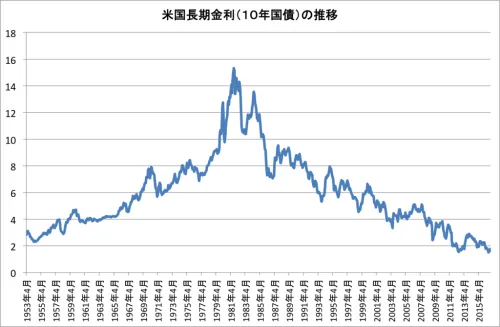
The bubble of an era where money further increased by borrowing, due to the leverage effect of inflation, will come to an end.
The rise in interest rates means that the repayment amount against loan debt will increase, leading to a halt in long-term company investments and resulting in business contraction and personnel reductions.
After being unable to withstand high interest rates and increased volatility, monetary easing was implemented in 1984, and interest rates began to fall significantly.
This means that money became easier to borrow again.
So, let's look at the US stock market composite index.
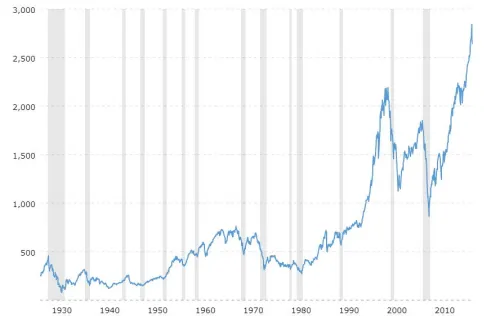
Compared to US Treasury bonds, which have continued to fall for about 40 years since their peak in the 1980s, the stock market continued to rise for 40 years after hitting rock bottom in the 1980s over approximately 15 to 20 years.
The above is when considered positively.
Conversely, if we look at past charts negatively, we can see that in 1980, it experienced the same stock prices as in the 1950s.
I think you'll realize that the risk of borrowing money has become abnormally non-existent due to the US zero interest rate era.
There are funds that continue to short (profiting if prices fall by holding the right to sell), pointing out in Bloomberg that the Bank of Japan's YCC (Yield Curve Control) has failed, and some are taking a similar position to George Soros, who is said to have crushed the Bank of England.
However, shorting can also be fuel for upward movement.
A Chinese nickel production company billionaire who had been continuously shorting nickel as a hedge also faced margin calls, especially when making large moves in a market where volatility has started to disappear after a bubble collapse.
And if you ask why government bonds will rise and interest rates will turn upward, it's because Governor Kuroda's term ends in 2023, which means the end of this market, the longest in history, and because the US FRB has also stated that it will end the zero interest rate era in 2023.
In the market, opinions were divided on the recent rate hike of 50bps and 75bps, and 75bps was decided by the recent FOMC. A very sentimental market.
75bps is the largest rate hike since 1994, and as monetary contraction is being actively pursued and the end of the zero interest rate era has been declared, it is highly likely that interest rates will rise long-term from now on.
And can money continue to be lent at zero interest rates forever? I think the answer is no.
I believe we, who are now eating into the assets of past bubbles, will be the ones to pay the price.
Due to COVID-19, the US, Japan, and the world, which had been planning rate hikes since 2018, suddenly saw the virus spread, and monetary easing was forced.
The bill for the 100,000 yen or more we received may come back to us.
When Will the Price Surge End?
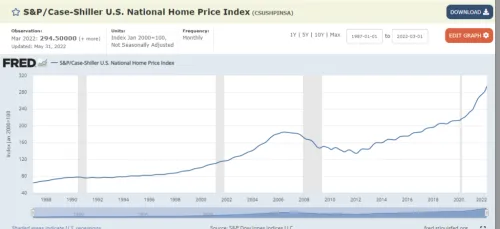
The rate of increase in US housing prices continues to rise without stopping.
In other words, it is clear that rate hikes are not keeping up with the acceleration of inflation.
The fact that housing prices are rising means that rental prices will further increase from now on, and the price surge will continue.
Will that really happen?
Here, let's look at the US personal savings rate.
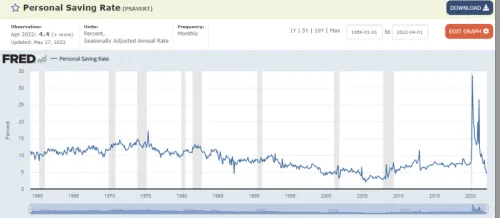
Under circumstances where American citizens are suffering from this inflation to a degree equivalent to the Lehman Shock when Lehman Brothers collapsed.
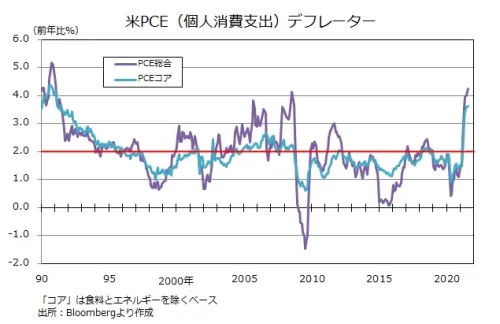
The above is a chart showing the growth rate of personal consumption expenditure.
Can America withstand this inflation?
My prediction below
I think we'll know within a year, but my prediction is that a strong dollar will put pressure on American citizens.
In a strong dollar situation, regardless of whether it's Euro, Won, Ruble, Yen, or Yuan denominated in dollars, import prices, including energy, will soar.
Similarly, considering what happened around 1974, it seems the inflation market continued for about another 10 years. But now, with the spread of the internet, where transactions and information flow are all fast, will it proceed in the same way?
Even before the Lehman Shock, the popularity of "Second Life," similar to the current metaverse trend, can be unearthed from internet fossils.
Around December, I told a friend from high school that the Nikkei Stock Average would rise, and US stocks would be unable to recover for a while.
Of course, I think stock price declines happen globally simultaneously, but those with weaker declines will rebound strongly.
Comparing the Nikkei Stock Average and the US stock index S&P 500, the Nikkei Stock Average has a weaker decline.
And semiconductor factories in Japan include Kioxia, spun off from Toshiba Memory, and Taiwan's TSMC, with investment from SONY. The internet bubble collapsed at the turn of the millennium in 2000, but surviving companies like Amazon, Google, and Apple are thought to have seen assets that were too dispersed in the first bubble concentrate in the next second wave bubble, leading to significant rises.
I think it's undeniable that the wealthy control everything, but for them to profit, "volatility" is necessary. These are the people who make money from price fluctuations.
For that reason, in the current situation where Japan's future is viewed with total pessimism, and with foreign investment now flowing into Japan, I cannot possibly imagine a future where it continues to decline.
According to "Global Macro" from Global Macro Research, my favorite economic information site, I believe Japan is sufficiently undervalued.
From Ogawa Seisakusho's statistics, if Japan, which has not moved its savings since the bubble era, starts to become active in investment, I feel that the liquidity of those funds will be very significant.
US prices will fall significantly within about 5 years due to rising interest rates, the 10-year US Treasury yield will rise significantly due to rate hikes, and I believe the US stock market index will continue its journey of searching for a bottom until the next monetary easing.
Therefore, depending on long-term interest rates, I believe there is a very real possibility of seeing the bottom 10, 20, or 30 years from now.
I think there is a near future where, even with rebounds in an inflationary market, it will fall without reaching its peak.
Will the next rise be monetary easing after a direct US war? Or something else?
What do you all think?